The problem
Before a start date, each new hire must provide personal data and documents, and which ones depend on their circumstances. HR collected them by email and phone and chased what was missing. Per HR, this could take several days per person.
The team is 3-4 HR staff working one shared pool of roughly 5-7 new candidates a week. Source: interviews with HR.
Options I weighed
| Option | Pros | Cons | Final solution |
|---|---|---|---|
| Web form | Structured answers | Not all questions require structured answers | All data is gathered in the chat |
| Fully automated process | Faster process, not depending on people | Documents from state administration come in too many types to trust the AI to cover every case | Final HR review |
| Keep email and phone | No build cost | Days per candidate, manual chasing | Replaced by the chat and review flow |
The decision
I chose a chat for candidates with a persistent document panel, and a single review gate for HR. The principle: candidates need one place to go, and HR needs one place to decide.
-
One conditional checklist, with non-applicable items kept in the count
Because: the list stays consistent for every person. Trade-off: the first message has to explain it.
-
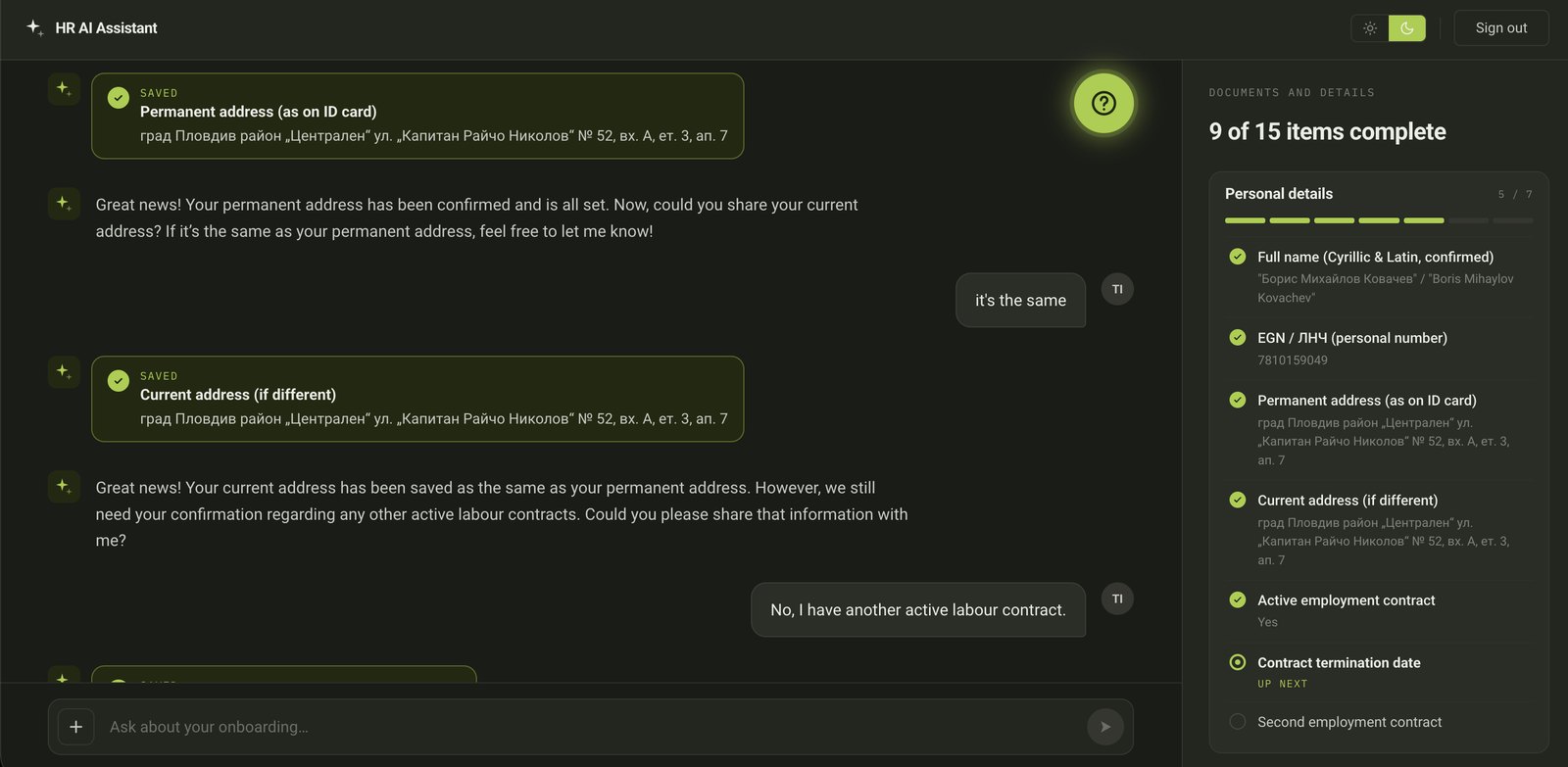
Everything happens in the chat, including marking an item "not applicable"
Because: one interaction model for the candidate. Trade-off: the chat carries more than conversation.
-
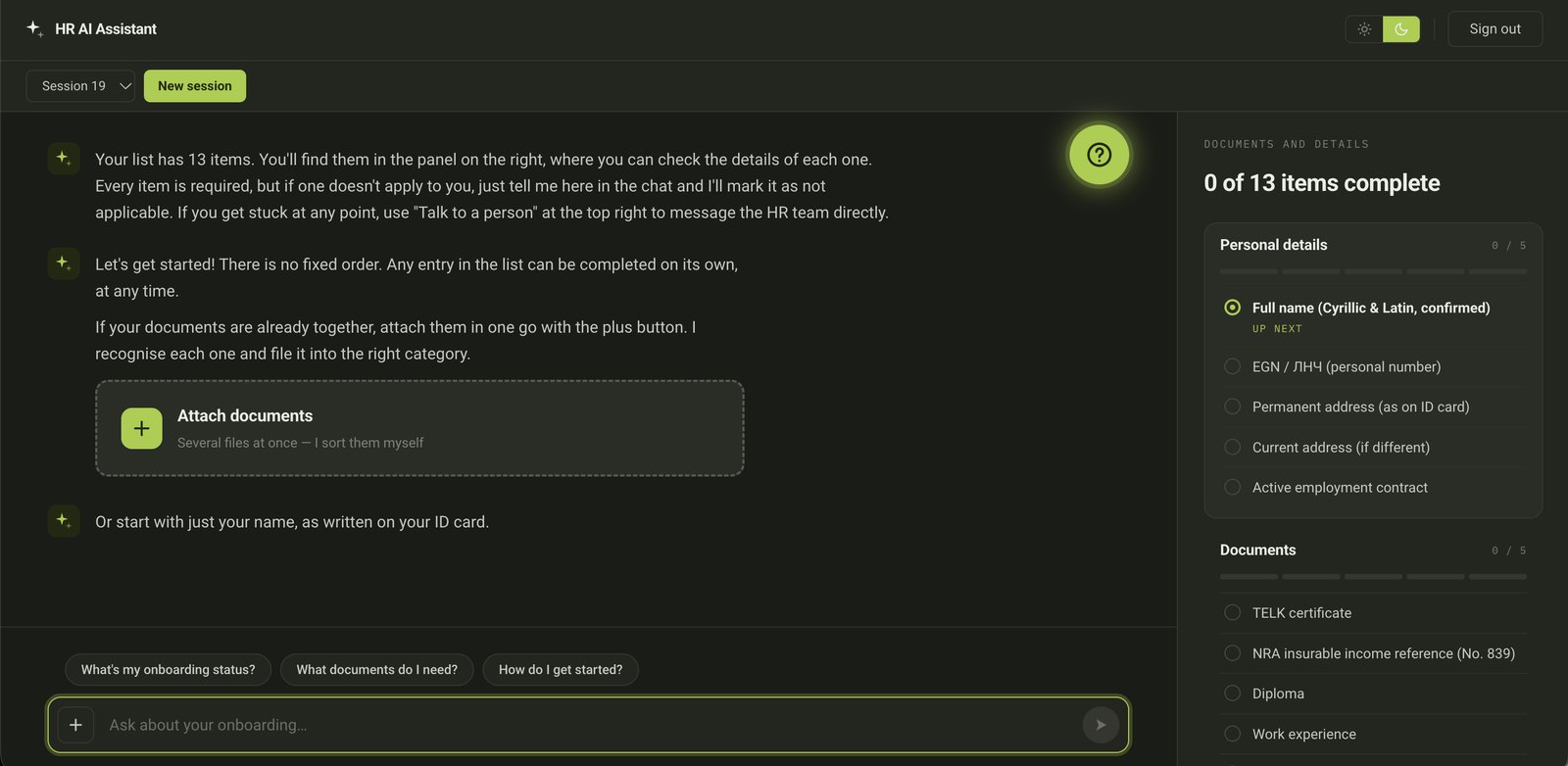
A persistent document panel beside the chat, instead of tracking documents only inside the conversation
Because: it is always visible with no scrolling and helps users focus on the end goal. Trade-off: more UI, and users initially missed it (see failure 2).
-
The LLM recognizes document types and cross-checks names and personal ID numbers between documents, flagging every mismatch in the admin panel for HR to accept or reject
Because: I wanted a human making the final confirmation. Documents from state administration come in many types, and the AI cannot be trusted to cover every case. Trade-off: HR still reviews every flagged item.
-
Completion is a manual HR action, which pushes to the HR system and notifies the manager and onboarding buddy
Because: the same human-in-the-loop principle. Trade-off: a manual step.
How I judged quality
- What I tested
- The working product, chat and admin panel, in iterative rounds with real users.
- Who
- 11 recent hires, chosen because they could compare against the old process, with mixed tech-savviness.
- Task
- Complete the full pre-boarding process while HR validated all collected data and documents through the single gateway.
- Pass criteria
- None fixed in advance. I made fixes between rounds, so the rounds are not comparable and I do not claim an improving rate. I judged by whether people finished and how long it took.
- LLM features
- The model failed in many ways during development, and I worked through them with repeated system prompt adjustments. I tracked document-type recognition, name and ID mismatches, and conversational behavior. A human reviews every flagged mismatch.
- What I did not measure
- The accuracy of recognition and mismatch detection as a rate.
Result, and what it does not prove
| Claim | Evidence | Status |
|---|---|---|
| Collection took several days by email and phone | HR's own estimate | Stakeholder statement |
| 9 of 11 testers completed the full flow, all in under 20 minutes | Test sessions | Validated in test |
| v1 is live | First production candidate went through the flow on Nov 23 | Shipped, no production data yet |
What this does not prove: the 20-minute figure covers only the 9 completed sessions and comes from test conditions. The days-versus-minutes comparison also measures different things: HR's figure is elapsed time including waiting, mine is active time in the chat.
What failed, and what I would change
Failure 1: the model kept asking for a document the user didn't have
- What I saw
- 2 of 11 test sessions looped on a missing document, and those candidates could not finish.
- What I changed
- I added explicit system prompt instructions that users can skip a step and complete it later. The fix has held up in later sessions.
- Still open
- Only the first production candidates have gone through so far, so it is untested at production scale.
Failure 2: users missed key controls
- What I saw
- Users rarely found "Talk to a person" and initially missed the documents panel.
- What I changed
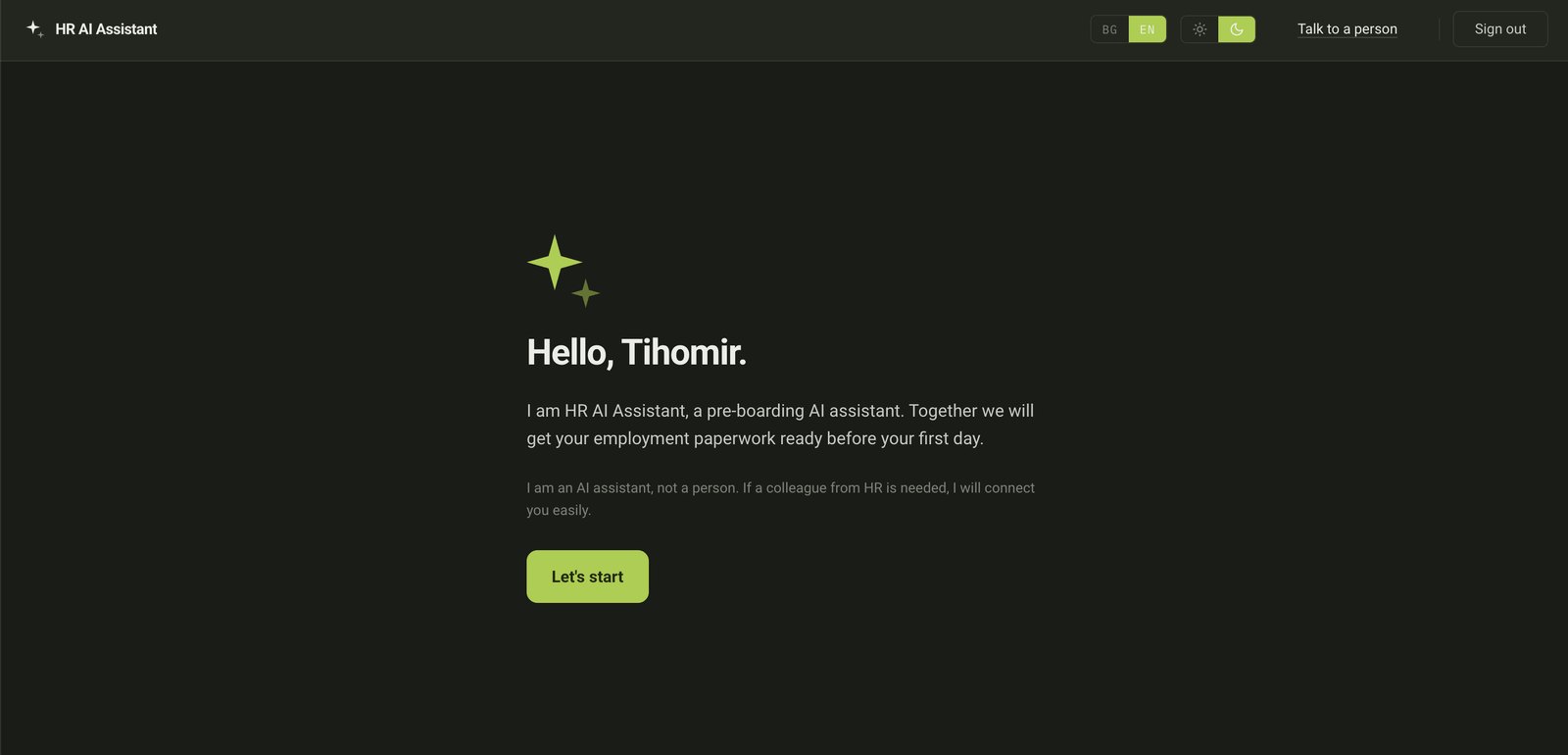
- I rewrote the chat's first message in Bulgarian and English to explain the item count, that every item is required, the right-hand panel and the contact button. I also redesigned "Talk to a person" as a floating button inside the chat panel, instead of in the app header. In later sessions the new first message made starting the chat easier and reduced confusion.
- Still open
- This is based on observation in testing, not a measured result. Onboarding, the next phase, will bring more variation in documents and steps.