The problem
The idea for FORG came from a project that failed at go-live. I joined it mid-way, when everything was already settled. One product manager led the conversations with a business team, and development started from those conversations.
- What went wrong
- Nobody had written down or challenged what problem the solution had to solve, what was in scope, or what "working" meant. The gaps stayed invisible through about 4 months of development and validation and appeared only in the first week in production.
- Cost
- About 4 months of development and validation did not deliver a usable solution, and the team had to start almost from scratch. The expensive part was not the building but that the wrong assumptions were found only at go-live.
- How I know
- First-hand. I was on the project from the middle onward and saw it go live and fail. This is one project, not a study of how discovery usually goes. It is the reason I built FORG: discovery that forces the problem, the scope and the validation to be written down and challenged before development starts.
The decision
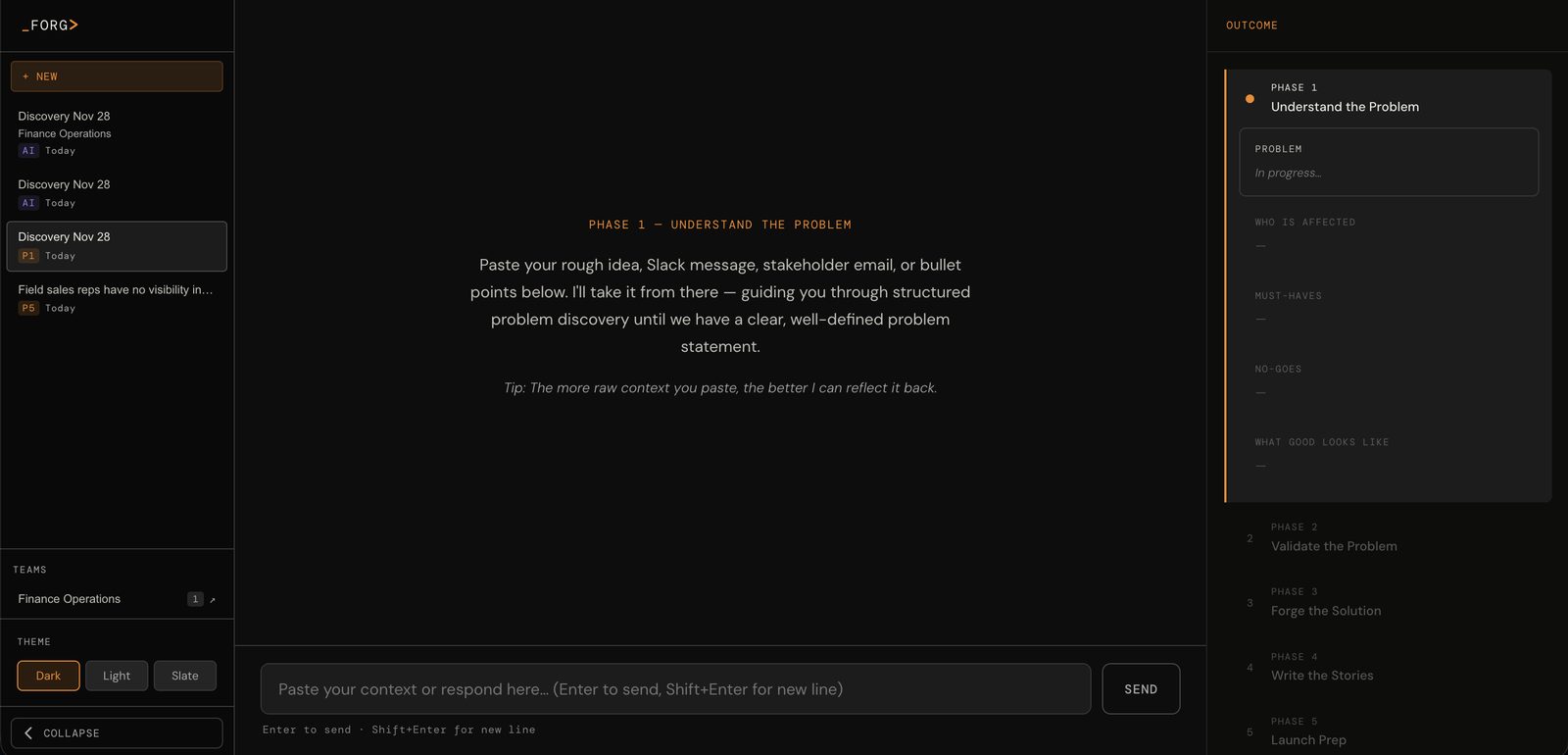
I built discovery as five phases. Each phase is a short interview that ends in a fixed output card, and the next phase starts from that card.
| Phase | What it works out | Output card | Where it pushes back |
|---|---|---|---|
| 1. Understand the problem | What is actually broken, and for whom? | Problem definition: problem, who is affected, must-haves, no-goes, what good looks like | Answers that describe a solution, a symptom or an assumption instead of an observed problem |
| 2. Validate the problem | What exactly are we building in v1? | Solution brief: solution, in scope, out of scope, constraints, open questions with owners | An empty out-of-scope list; scope that contradicts a Phase 1 must-have |
| 3. Forge the solution | Does the flow work for real users? | Prototype spec, then a solution spec after testing | Skipped steps in the flow; edge cases without expected behaviour; a vague validation plan |
| 4. Write user stories | What are the dev-ready stories, in what order? | Story set: summary table, delivery sequence, full stories in the team template | Stories too large to build; ignored dependencies |
| 5. Launch prep | What do people need to read when it ships? | Release notes, Slack announcement, user documentation (each optional) | A mismatch between audience and tone |
- How it interviews
- One question at a time, in a fixed order. An answer is accepted only when it is concrete, and one firm push per point is the rule. Every phase opens by carrying in the previous card and asking whether it still holds, and a conflict between phases, such as a must-have scoped out, is raised immediately.
- Where a human decides
- The assistant drives the questions, but the product owner makes the calls: whether the problem is right, what is parked, whether the prototype passed validation, and whether stories are pushed to Jira (only on explicit opt-in).
- Because
- The usual failure in discovery is jumping from a rough idea to a solution. Forcing the order problem, scope, prototype, stories gives a product owner no way to skip the thinking, and each card is a document they can take away.
- A second mode
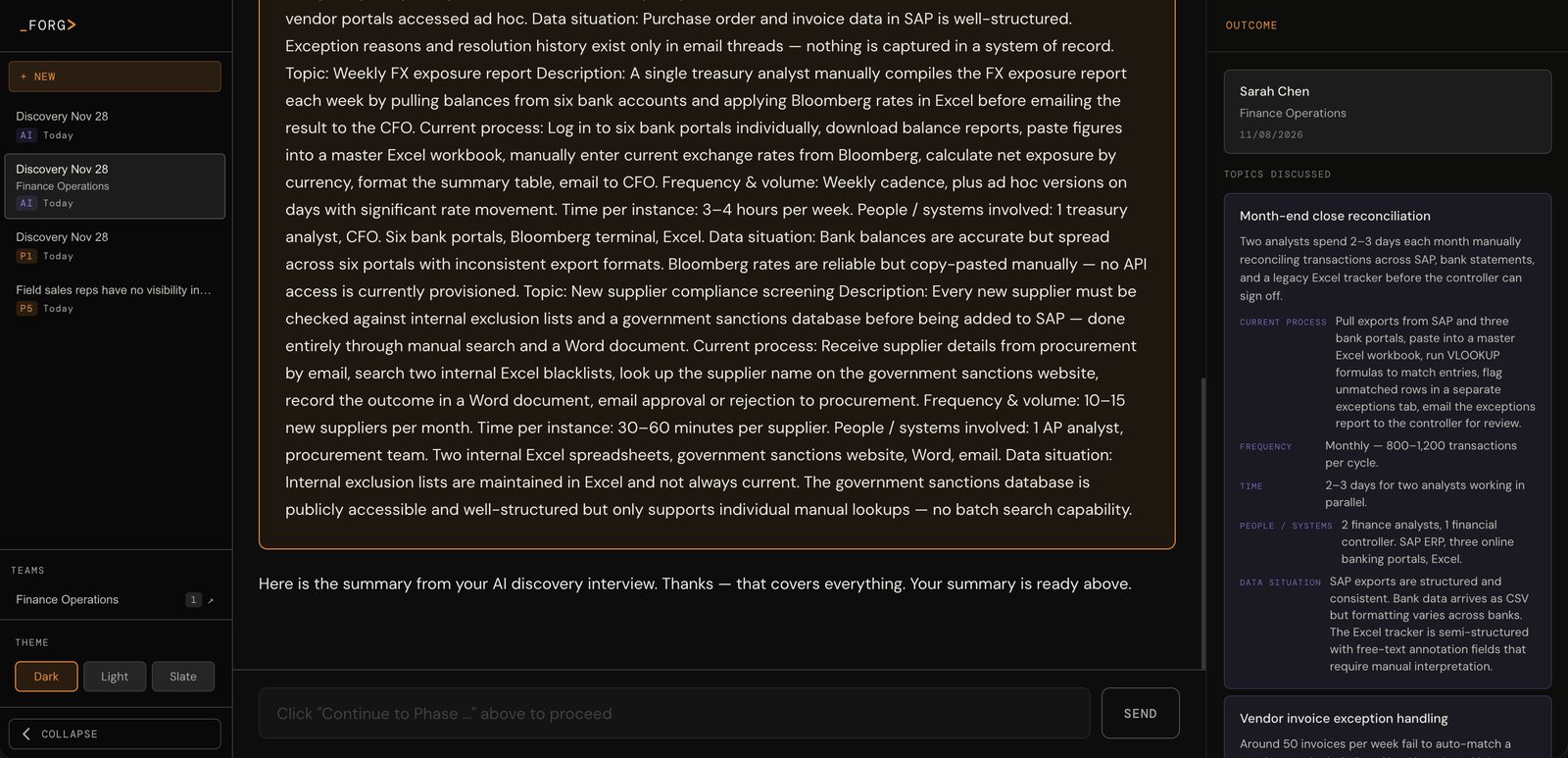
- AI Discovery interviews teams about their workflows and pain points to find automation opportunities. It collects structured data, then aggregates several interviews to surface recurring use cases, scored on impact and feasibility.
What it looks like
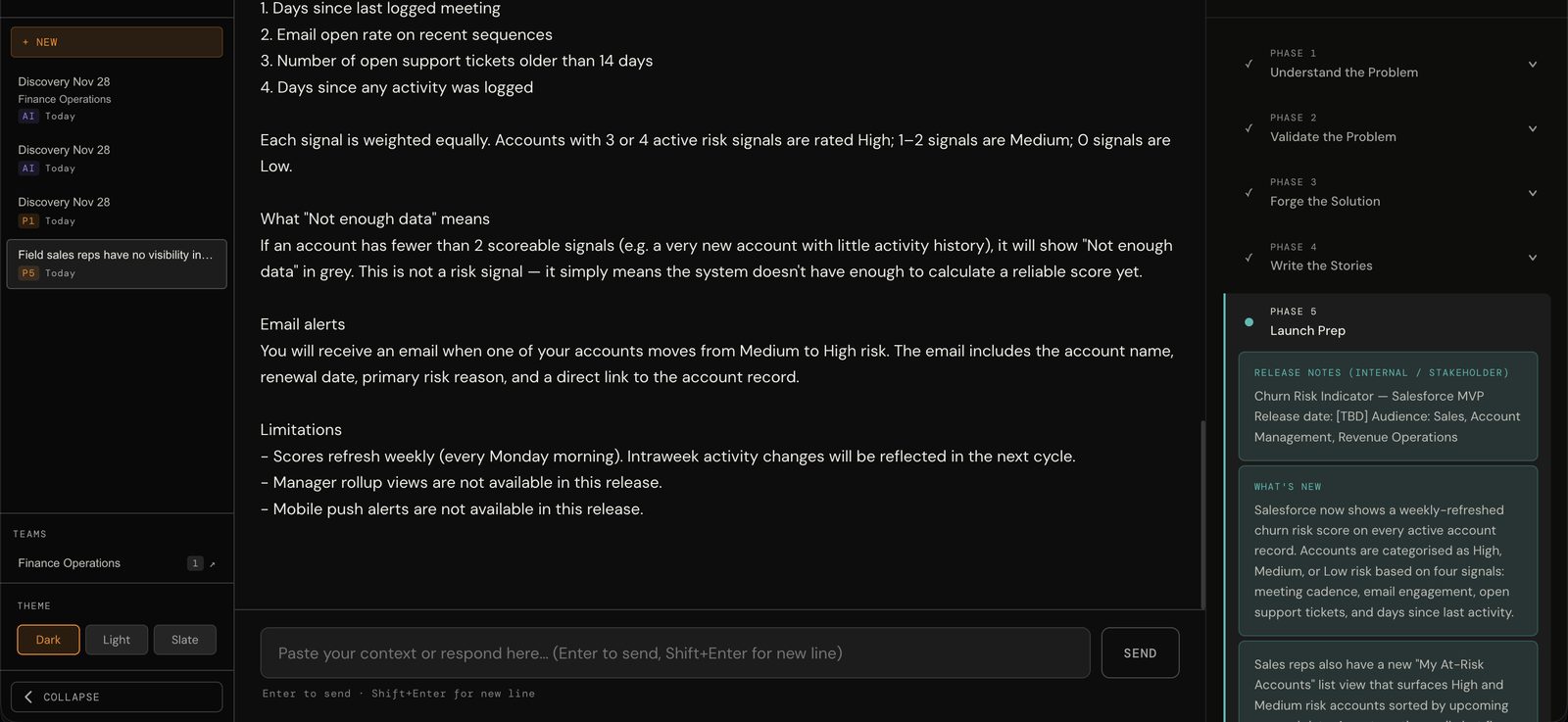
The screenshots use sample data, not real team input.
How it is built
| Design choice | What it means |
|---|---|
| Phase logic lives in system prompts | Changing how a phase behaves means editing a prompt, not code. |
| Stateless backend | The full conversation history is sent on every call. Four serverless functions handle chat, export, aggregation and tracker export. |
| Output cards as XML tags | The model wraps each deliverable in an output-card tag, and the front end parses it into the outcome panel on the right. |
| Prompt caching; Haiku in development, Sonnet in production | Keeps iteration cheap while production uses the stronger model. |
| Session kept in the browser | Progress is stored in local storage. There are no user accounts, only one shared password. |
| Exports | The transcript goes to Google Docs and the use case tracker to Google Sheets. |
The stack is React with Vite, Anthropic Claude, and Vercel serverless functions. The shared password and browser-only storage keep it simple for a small team, but there is no per-user history or access control.
How it evolved
FORG was not designed in one go. It is the result of about 4 months of iterations.
- 1. A brainstorming skill
- The first version was a Claude skill for brainstorming.
- 2. Five phase skills
- It became five skills, one per phase of discovery, each building on the previous output.
- 3. A dedicated app
- The phases moved into a dedicated app with an outcome panel, session persistence and exports.
How I judged quality
I tested FORG by using it on real work myself and refining it over about 4 months. There is no formal evaluation yet, so the design itself carries most of the quality: each phase is built to stop the failure that sank the project behind it.
- Designed against a real failure
- The project that failed at go-live had no written problem, no explicit scope and no validation before development. FORG makes each of those a required step: the problem is written and challenged first, scope and what is parked are stated, and a prototype is tested before stories are written.
- Controls built into the design
- Pushback rules per step, explicit accept criteria, conflict checks between phases, and human confirmation before anything is pushed to Jira.
Result
| Claim | Evidence | Status |
|---|---|---|
| A working product, built end to end | Five phases plus a second mode for finding AI opportunities, an outcome panel, session persistence and exports to Google Docs and Sheets | Shipped |
| Used by my team | Used by me and 4 other PMs, across more than one team | In use |
| It gives a less experienced PM a structure to work from | It helped a lot the PM who came from QA and had little product management experience. I use that case because it shows the value for less experienced product people. | My observation |
Evidence so far: real use by five PMs and my own observation. I have not run a before and after comparison.